Source:|Author:佚名|Published time: 2018-11-15|2576 Views|🔊 Click to read aloud❚❚▶|Share:
These are the nuts which are found being used in order to make up the long rod assemblies from shorter lengths of the rods. The rods are also threaded along with the coupling nut for a particular distance only.
Coupling nuts are the found having their application in tightening a rod assembly in the inward direction or in order to press a rod assembly in the outward direction. The connecting nuts are the ones amongst the frequently used nuts for making the bearing at home as well as the seal pullers or the presses at home. The main advantage of a connecting nut as compared to a standard nut in this application is that with respect to its length there is a greater number of thread which is observed to be engaged along with the bolt. This is the reason which allows you to spread the force over a larger number of threads, which is responsible for reducing the possibility of stripping or galling the threads due to the effect of heavy load.
7. Flange Nut: ( Types of Nuts )
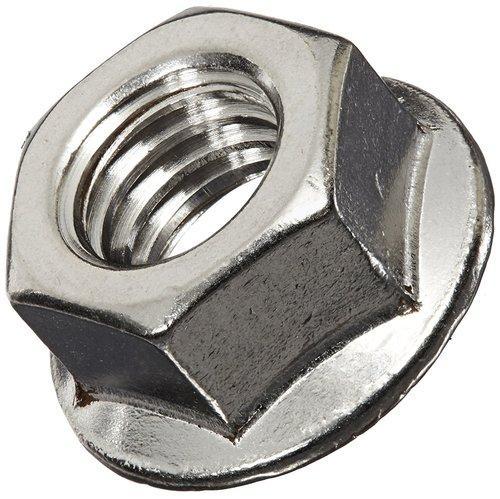
Flange Nut
A flange nut is referred to as a nut which is found having very wide flange at one of its end which usually acts as a washer which is already integrated. This is what serves in the distribution of the pressure of the nut over one of its part being secured or reducing the chance of damage for the part to make it less likely to loosen as a result for an uneven fastening surface. Flange nuts are the ones which are commonly found in the geometrical shape of a hexagon and which is also made up of hardened steel along with being coated with zinc.
The flange can be observed to be serrated in order to provide any sort of locking action. Taking your attention towards the serrated flange nut then it must be said that the serrations are particularly angled in such a way that they keep the nut away from the rotating in the direction that would possibly be responsible for losing the nut. These serrations are the ones which cannot be used along with a washer or at any such surface without being scratched. The serrations are responsible for helping to prevent the vibration of the nut from moving the fastener. This is what is responsible for maintaining the actual holding power any type of nut.
Flange nuts are provided with a swivel flange which is responsible for giving more stability to the structure and does not at all affect the finishing of the product similar to a serrated flange nut. Swivel flange nuts are the ones which are most commonly used for the application of joining materials like wood and plastic.
8. Self-Aligning Nut: ( Types of Nuts )
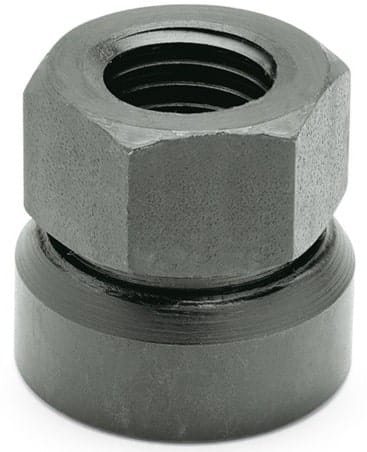
Self Aligning Nut
A self-aligning nut is also termed as a spherical nut or a levelling nut which is one amongst that type of nut that is mostly found having its applications at all those places wherever the fastener is not set at an angle perpendicular to the surface of the nut anchors. These are the ones which are commonly used in the industries like aerospace. If these were the types of nuts which were changed then it would be replaced with any other type then not used the object would have to be spot faced perpendicular to the fastener.